Don't Be a Stranger
A permanent museum installation where two strangers pick up old rotary phones and talk to each other, live, across two museums in Gothenburg.
- No.
- 02
- Year
- 2025
- Medium
- Museum installation, MSc thesis
- Role
- Sole designer and researcher. Research, build and install, all of it.
- Where
- Röhsska Museum and Mölndals stadsmuseum, Gothenburg.
- Worked with
- Curators, a graphic designer, a communicator and a pedagogy lead across both museums.
- Status
- Still running, two museums
Röhsska Museum, filmed on site. The sound is faint: someone reads the instructions aloud and says a few numbers.
Pick up The problem
Pick up the phone in one museum and you are talking, right now, with a stranger standing in the other one. There is no screen and no profile to look at, only a voice, and before it the dialling and the wait to see whether anyone answers.

Everything here can be touched. Tap the phone, the Rolodex, the post-its or a poster to look closer.
Everyone who used it was told, in writing and in both Swedish and English, that no call is recorded. The photographs of visitors on this page are published with their permission.
I grew up in a small village in Greece where the phone booth was how I called home, and I still have the prepaid cards I saved. The first version of this project was booths between cities. I wrote to telecom companies in Sweden and Denmark, Ericsson first. They said no, or never answered. Then I found the Ericofon, the exact phone I had in mind, already in a case at Röhsska: behind glass, where nobody could touch it.

We message people on the other side of the world without thinking, and reaching out has lost its weight. Museums lean the other way: much of their signage asks you to look and not touch. Before designing anything, I photographed those signs in museums in and around Gothenburg.

Two thinkers gave me words for what I had felt for years. A friend introduced me to Baudrillard’s essay during a phone call.

Marshall McLuhan was a media theorist. His point: the way we communicate shapes us as much as what we say.
Understanding Media, 1964
The medium is the message.
We notice what a medium carries and forget the medium itself.
So the weight of the handset and the resistance of the dial stay. They are how you feel the medium.
McLuhan split media into hot and cool. A hot medium fills in everything for you; a cool one leaves gaps you have to fill yourself, so it asks you to take part.
I’d argue a rotary dial is as cool as a phone gets: every digit is a small act you perform, and you wait for the dial to run back. That participation is the point of the installation.
About the clip. In the clip he answers questions on the medium and the message.

Jean Baudrillard was a philosopher and a critic of “hypercommunication”: contact so constant that it stops meaning anything.
The Ecstasy of Communication, 1987
…a switching center for all the networks of influence.
Everything is immediate and exposed. Distance, delay and absence collapse, and so does meaning.
So the delay comes back: a slow dial, one call at a time, and the chance nobody answers.
In The Ecstasy of Communication Baudrillard says we no longer stand in front of a scene and look at it. We sit inside networks, and everything reaches us at once. He calls this hypercommunication: so much contact, so immediate, that it loses its meaning. In his words, the subject becomes a switching center for all the networks of influence.
The thesis takes that diagnosis and tries the opposite: one line, one stranger, no feed, no profile, and a real chance of silence. The distance and the waiting are what make a call feel like something again.
About the clip. In the clip he is interviewed in Oslo about the art of disappearing.
The question I ended up withWhat should be considered when designing an interactive museum exhibition exploring themes of meaningful telecommunication technologies?
Dial What I did
I worked on that question through research through design: build the thing, put it in front of people, and watch what they do. Below are the installation’s own instructions, reimagined to work on this website: pick up, dial a number from the card, and wait.
Don’t be a Stranger
Rotate the dial and talk to someone who might just make your day.
To make a call
- 1Pick up the phoneYou’ll hear the dial tone.
- 2Dial a number from the cardPut a finger in the hole and turn the dial all the way to the metal stop, then let go.
- 3And waitSome numbers connect. Any other seven digits ring out, like a call to the other museum: nobody will answer here.
- 4Hang upPut the phone down whenever you like.
The phone is on the hook.
Numbers worth dialling
- 1916A song about the telephoneDonga, “Pelo Telefone”, recorded 27 November 1916
- 1969A call to the MoonThe White House to Apollo 11, 20 July 1969
- 1977Hello from EarthGreetings to strangers in space, on the Voyager Golden Record
It took three stages.
- 01LabIxD studio, Chalmers
- Rotary dial + Bluetooth + smartphone with a SIM, since Sweden has no landlines
- Nine second-hand phones tested
- 02FieldLindholmen campus
- Three pilot rounds in a café and two corridors
- Poster, prompts, form and instructions revised between rounds
- 03ShowroomRöhsska and Mölndals stadsmuseum
- Co-designed with curators, a graphic designer and pedagogues
- Two installations, one per museum
- Nov 2024Röhsska, the first museum approached, and the first to say yes
- Nov 2024 – Apr 2025Looking for a second museum: emails, proposals, LinkedIn. Mostly no reply
- Mid-Apr 2025Mölndal agrees, through the Röhsska curator’s contacts
- May 2025Opens in both museums
And wait Designing for nobody answering
A lot of the project was waiting, for museums to reply and for calls that might never be answered.
My first signage said talk to a stranger. Röhsska’s curators raised a concern: promising that a stranger would answer could leave visitors disappointed when nobody did. The poster line became You might connect. You might not. But the moment is yours. From there I designed for the call not happening. Voice only, with no screen and no caller ID. No AI and no recorded voices, because an answering machine would have made the silence safe.
Beside the phone sits a Rolodex of prompt cards, to read on your own or with whoever you came in with. The curators, communicators and educators co-wrote the prompts with me, in four groups: the voice and the phone, touch and the senses, innovation at Röhsska or memory and everyday life at Mölndal, and poetic provocations. Four of them, from the Rolodex at Röhsska:
- Would you speak differently into this phone than into a smartphone?
- What did your fingers notice when you touched the phone?
- Did this feel like something you were “allowed” to do in a museum?
- If this phone had a dream last night, what was it about?
Sweden has no working landline network any more, so in the lab I paired each dial with a Bluetooth adapter and a smartphone with a SIM card. You turn a dial designed in the 1950s and it places an ordinary mobile call. I tested nine second-hand phones. Most had something broken, and I did not know how to repair any of it when I started.
Then three rounds on campus, in a café and two corridors, watching who picked up and who walked past. Twenty-five people took part across the pilots.
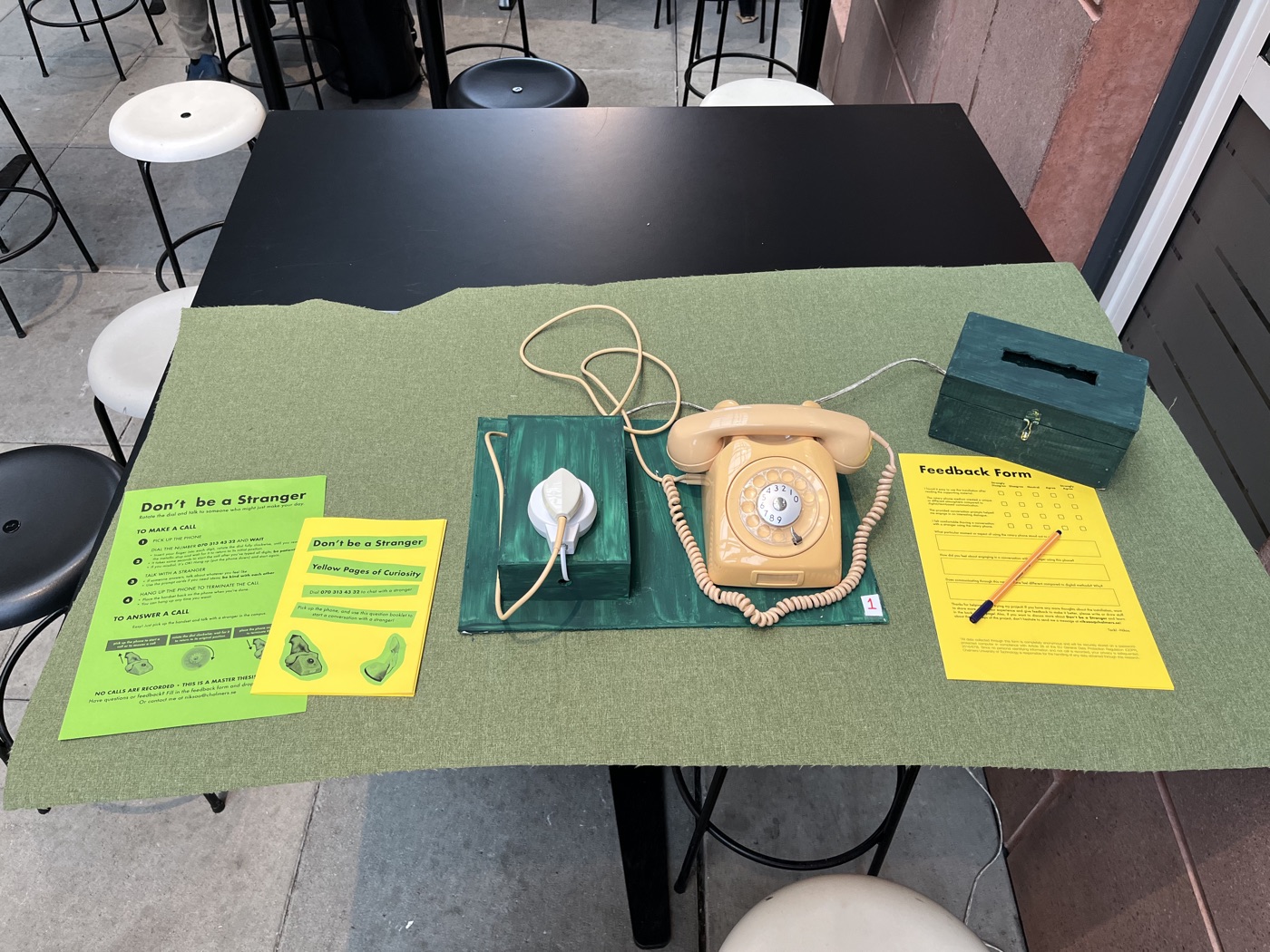
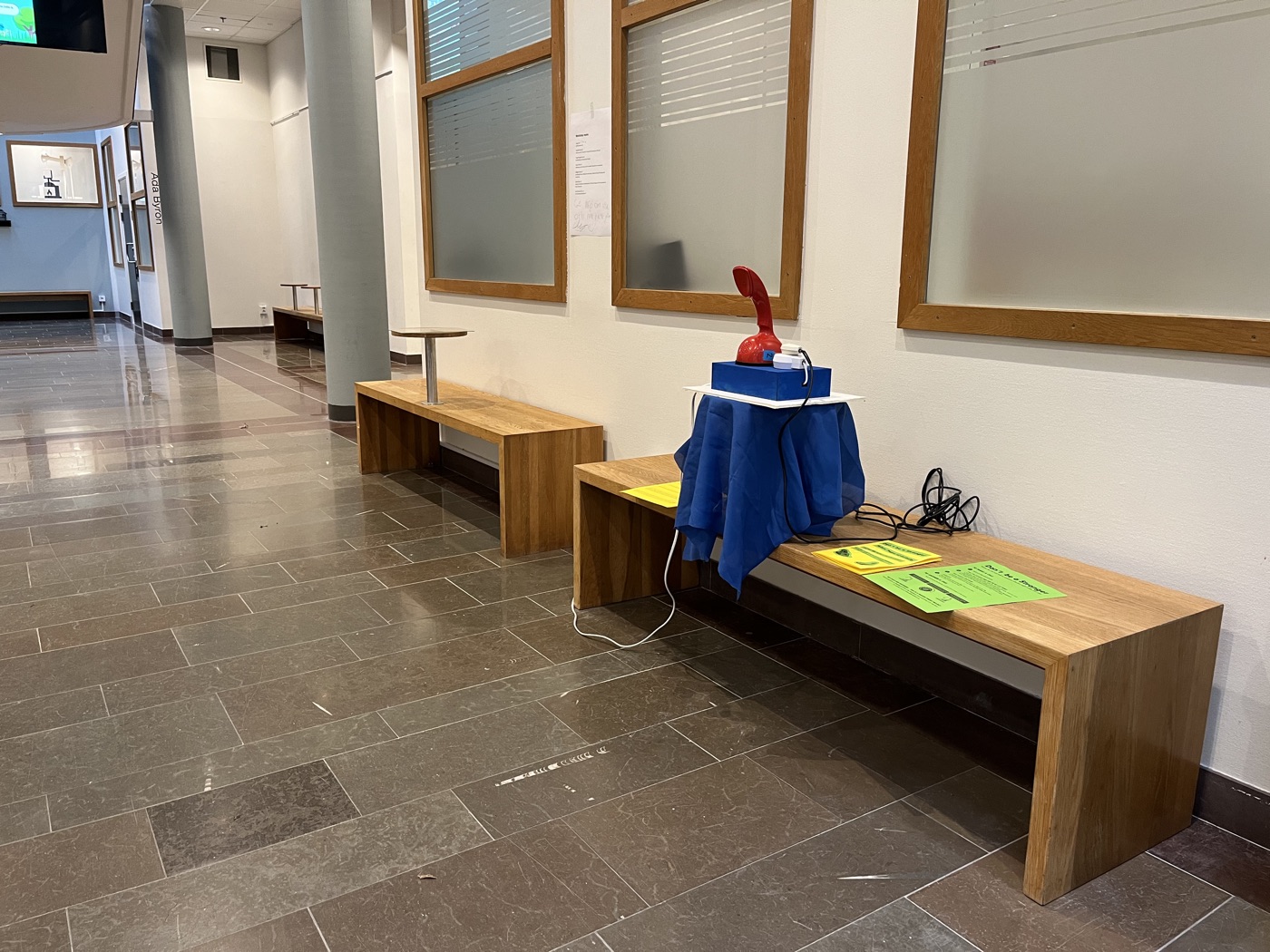
- Round 1Kokboken café and the Patricia corridor
The first setup: instructions, a prompt booklet and a feedback form, as first designed.
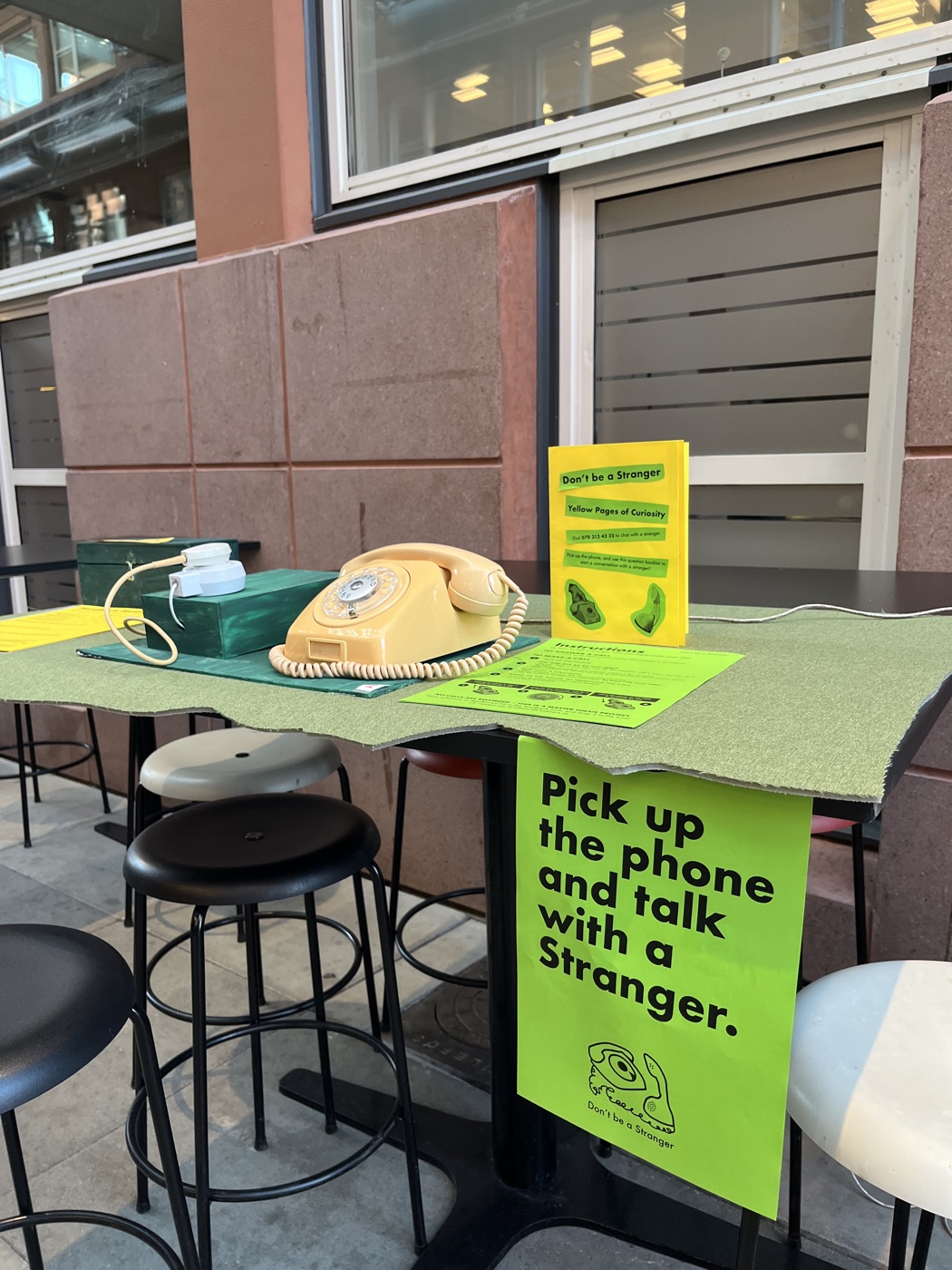
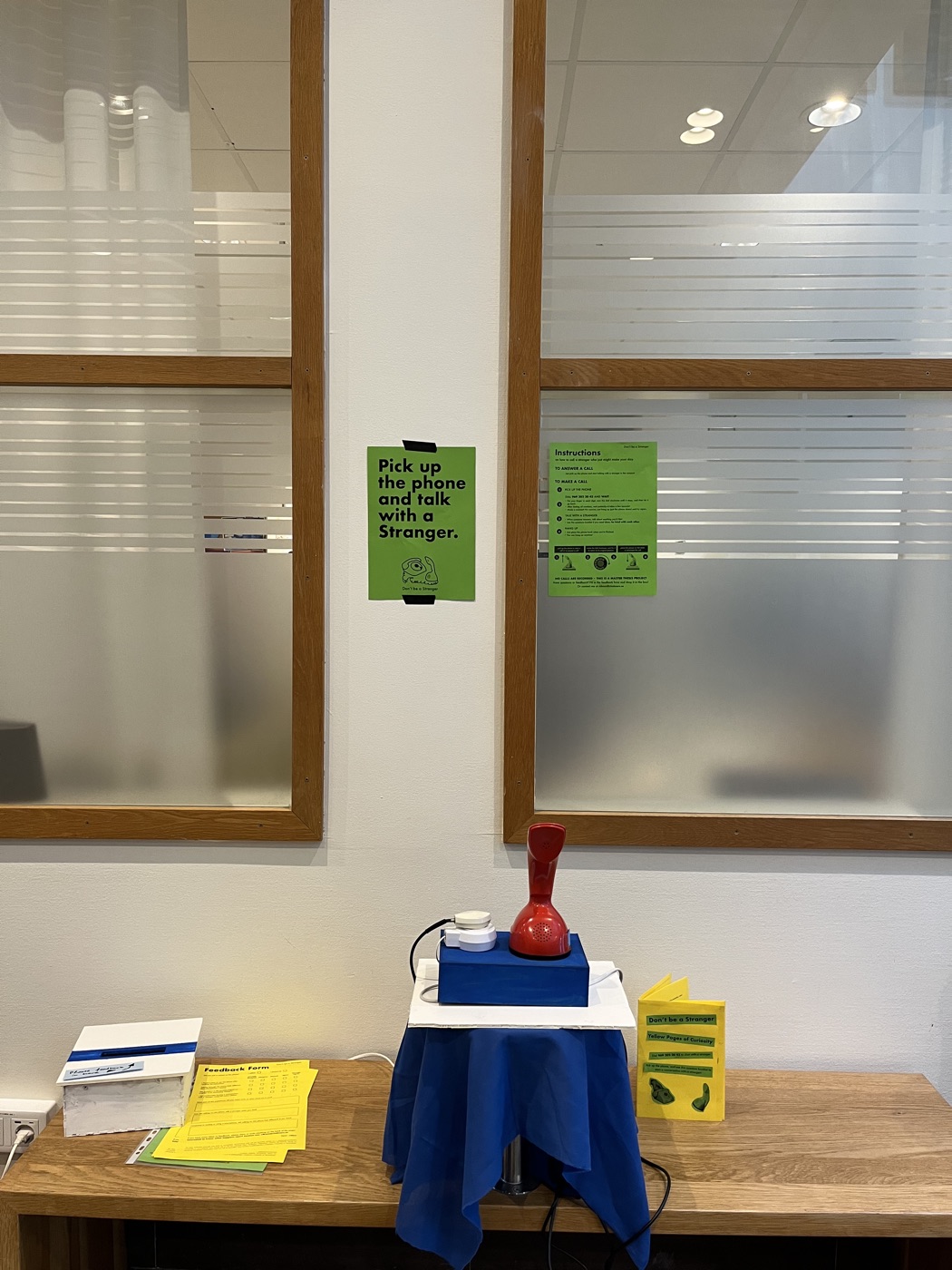
- Round 2Same two spots, after day one
A poster with the project logo to draw people in, a clearer prompt booklet and instructions, a shorter form.
- Round 3Patricia swapped for Jupiter, a busier corridor
Small fixes, printed in the studio next door and put out the same day.
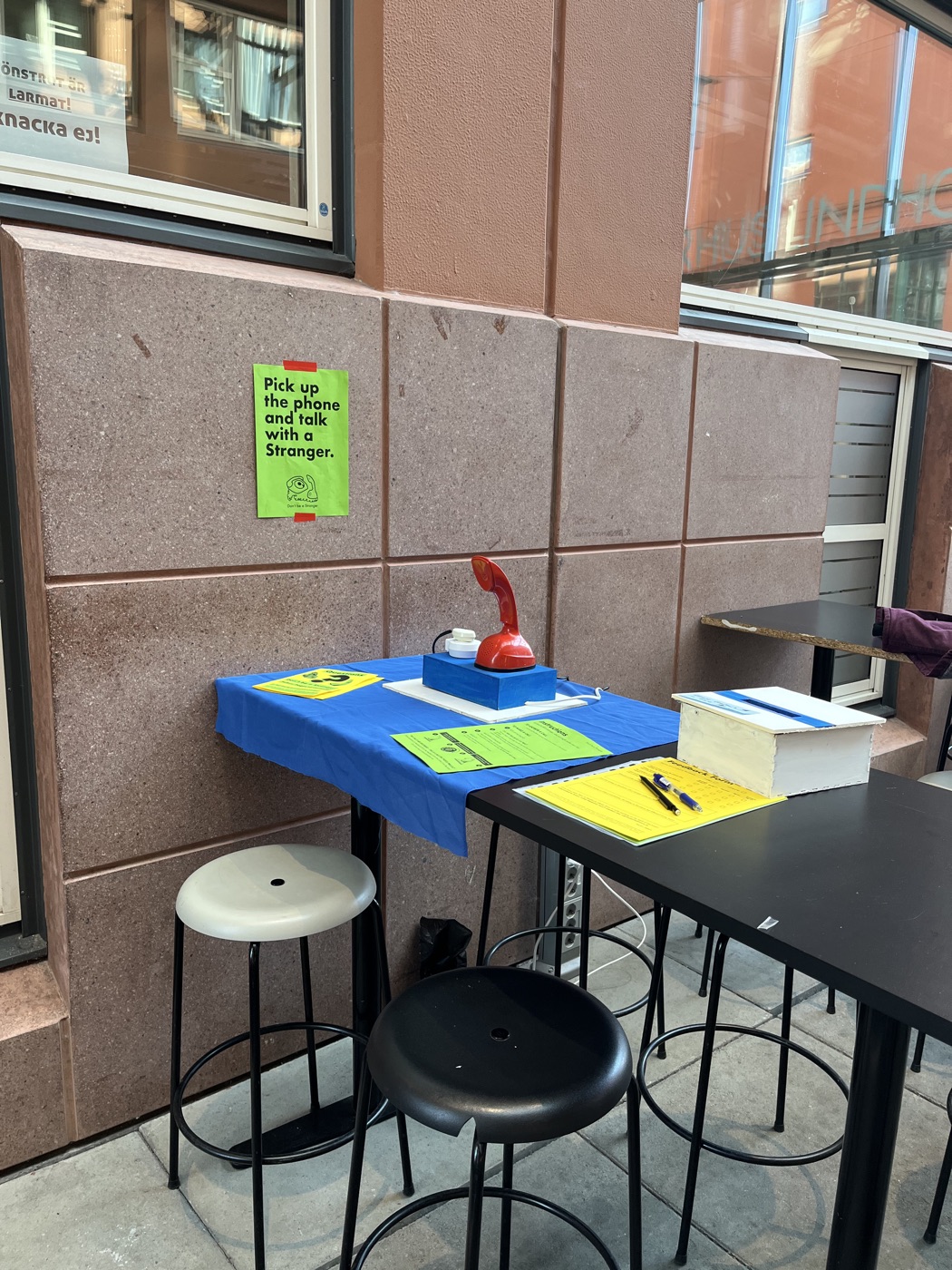
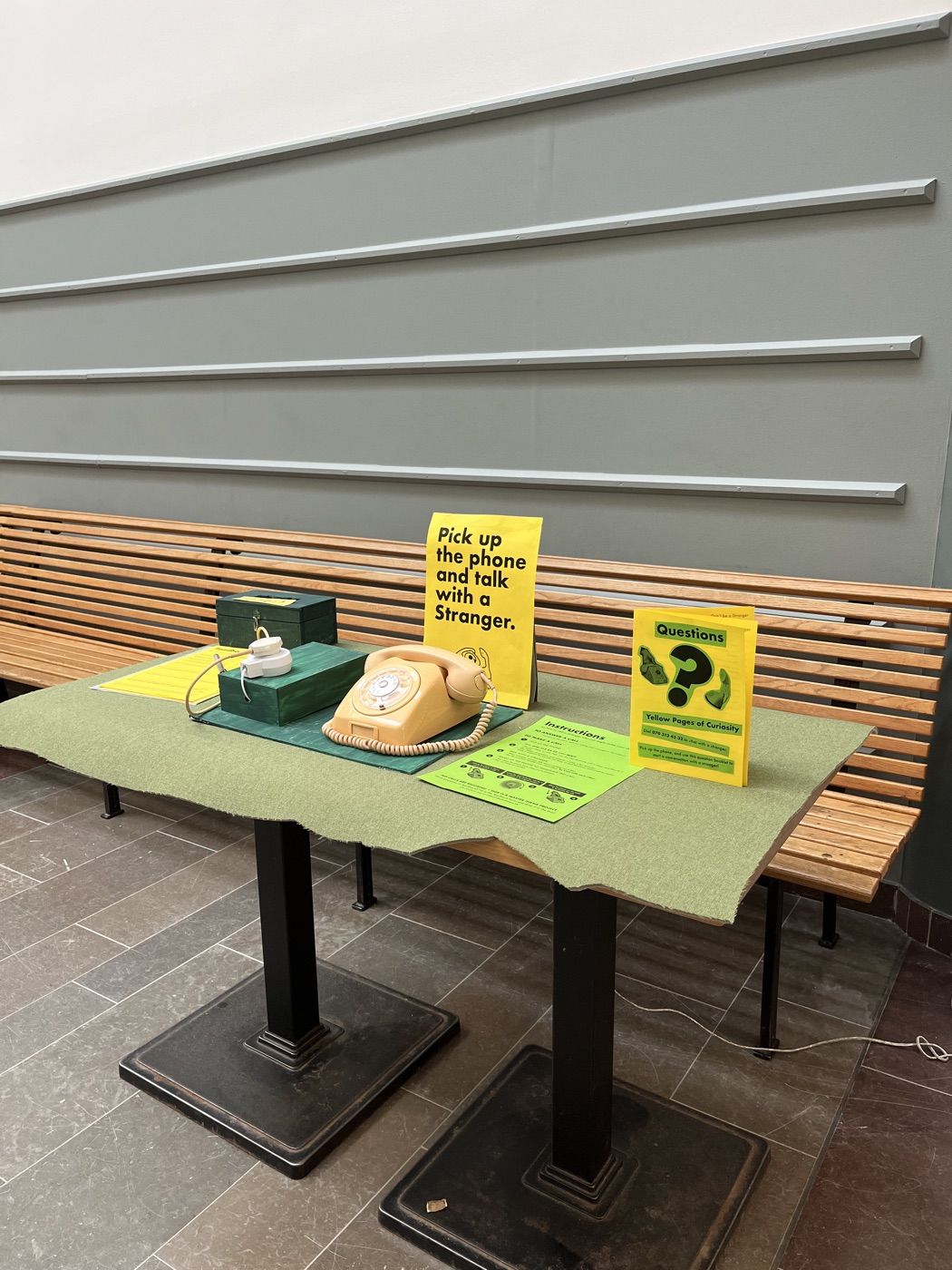


The fifteen feedback forms leaned positive, on a five-point scale: 4.4 for feeling different from a smartphone, 4.3 for being comfortable talking to a stranger, 4.1 for prompts that sparked conversation and 4.0 for ease of use. A small sample, so a direction rather than proof.
I coded the interviews and forms with reflexive thematic analysis. Five themes came out of it, and each one changed something before the museums. The table pairs each theme with the change it led to.
- AEmotional presence through analog voice
“Talking on this phone gives me a different vibe, it lets me be myself without putting too much effort.”
P4, pilot interviewSo in the museumsVoice only. No screen, no caller ID, and printed prompts that support the call rather than compete with it.
- BFriction and vulnerability as invitations
“The experience requires a little bit of vulnerability (not knowing what to expect, if someone will answer or not).”
P2, pilot interviewSo in the museumsFix the bad sound, keep the slow dial. The long phone number stayed long on purpose.
- CDefamiliarization and playfulness
“A bit strange but fun; it’s nothing I thought I would do today.”
P1, feedback formSo in the museumsExplain less. The structured form went; post-its and a guestbook asked one open question instead.
- DSocial norms and spatial hesitation
“[I] would triple check if it’s OK to pick up the phone.”
P6, pre-pilot interviewSo in the museumsSemi-sheltered but visible spots, signage that says the phone is for use, and a few post-its up before opening.
- EMaterial memory and nostalgia
“It feels the same as listening to vinyl; it’s more complex, takes more time, takes away the easiness, the experience becomes a thing of itself.”
P2, pre-pilot interviewSo in the museumsOriginal phones, a vintage box from Mölndal’s collection, and laminated cards on a Rolodex you turn by hand.
Even the instructions were tested. Interaction design students annotated my leaflet by hand, and the version that went into the museums had a step mine had missed.
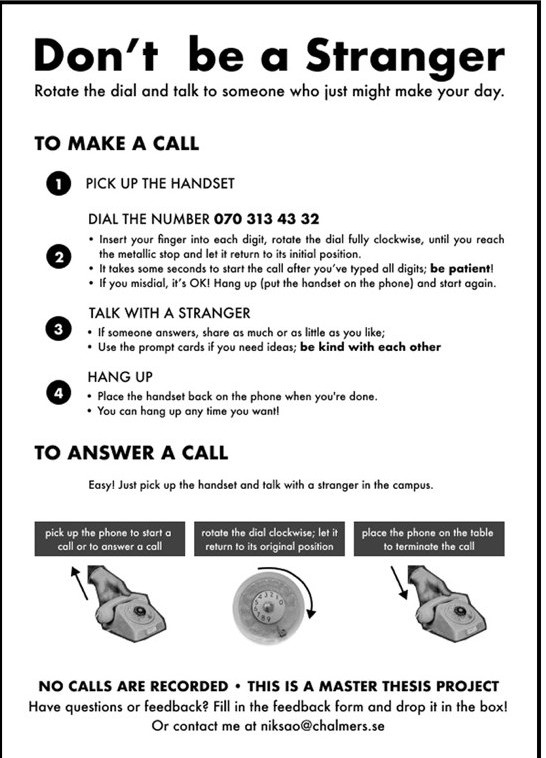
- Four steps to make a call, one to answer
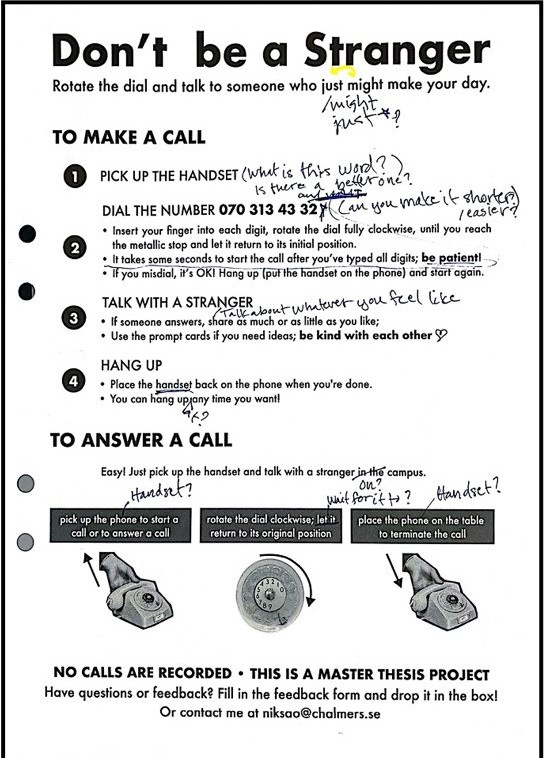
- “Handset?”: what is this word?
- “Can you make it shorter?”
- “Wait for it to…?”
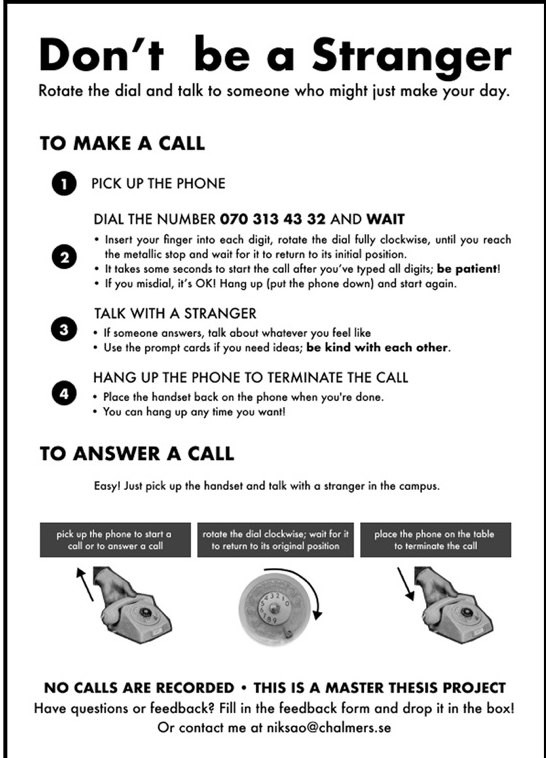
- “Handset” became “phone”
- “And wait” added to dialling
- Hanging up spelled out as a step


I approached Röhsska first, in November 2024, months before the thesis officially started, and it was also the first museum to say yes. Finding the second took about five months of emails, LinkedIn messages and tailored proposals, and most of them were never answered. My plan B was both phones in two rooms of Röhsska. What finally worked was a personal connection: Röhsska put me in touch with Mölndals stadsmuseum, and that did more than months of emails had.
- LinkedInCompany A
- EmailMuseum A
- LinkedInCompany B
- LinkedInCompany A
- EmailCompany C
- LinkedInCompany D
- EmailMuseum B
- LinkedInCompany E
- EmailMuseum C
- LinkedInCompany C
- EmailCompany D
- LinkedInCompany A
- LinkedInCompany F
- EmailMuseum D
First museumRöhsskaYes.
Once, the system itself made people wait. A lapsed payment on the phone’s cellular subscription cut the service for nearly two hours during the exhibition, and the museum staff were the ones standing in front of visitors while it was down. The technicians, receptionists and guides run the installation day to day, so I wrote the setup and troubleshooting instructions for them.
Talk How it went
Described at Röhsska as one of the visitors' favourites, and still there.
Co-created with both museums: their staff co-wrote the prompts, and we chose the Rolodex, Mölndal's phone and each spot together.
Twenty-five people across three pilot rounds before either museum.

It opened in May 2025 and it is still running. Visitors arrived in groups and started by watching. Once one person wrote on a post-it, others followed. Teenagers and young adults were the most likely to pick up and dial. An older man tried it alone, then called his partner over. A group of schoolboys tried to decode how the dial worked. Plenty of calls went unanswered, especially the ones to Mölndal, and people stayed anyway, dialling, listening to the tone, turning the Rolodex.
What they left behind on the table at Röhsska:

Tap any note on the table to read it.
I love the tactile act of dialing but I also noticed my impatience at how long it took. This made me a bit sad and frustrated at myself.
Jag minns alla tre fasta telefonnr. jag haft.
I remember all three landline numbers I’ve had.
We do not know which band uses this because they have not booked any concerts :(
Jag hade glömt bort hur telefonsignalen lät innan man slog numret! :)
I had forgotten how the dial tone sounded before you dial the number!
Jag blev glad :)
I became happy :) (written upside down)
Fun to use the big phone in your hand again! And dialing the numbers. So much fun & nostalgic!
Som mölndalsbo blev jag väldigt glad! ♡
As someone from Mölndal, it made me very happy!
ABBA would have used this type of phone, or maybe David Bowie.
I felt scared to talk on the phone, maybe reminded me of talking on house phone when I was a kid.
I would paint it dark green. It felt like I was part of history or I was calling someone in the past. Nervous to dial. Satisfying to dial. The dial tone is eeeeerie.
Min första egna telefon var en röd kobratelefon.
My very first phone of my own was a red Kobra phone.
Calm & ease
with a drawing of the dial
Social media is the death of sincerity.
Joy Division would use the phone.
Panik! Jag hade inte läst hela frågan innan jag ringde numret.
Panic! I hadn’t read the whole question before I dialled the number.
A drawing: a scribble and a small picture of the phone
It was so unexpected and fun! Very surprising to find this phone here.
One concept became two installations that look quite different, because each was co-designed with the people who run the room. I was the only designer and researcher. The curators, the graphic designer, the communicators and the educators brought what I could not: the museum’s story, its visual identity, a sense of how to speak to its visitors, and the right place in the room. Technicians, guides and receptionists keep it running every day. I came to each meeting with something to react to, and afterwards wrote up what we had decided and who would do what.
The museum staff brought
Röhsska
- Curator and exhibition producer
- The museum’s story and a place for it
- Graphic designer
- The visual identity
- Curator of pedagogy
- How to speak to visitors
Mölndals stadsmuseum
- Museum educator and coordinator
- Where it fits
- Communicator
- Visual communication
Both museums
- Technicians, guides, reception
- Mounting it, and running it daily
Made together
- The prompts and the poster line
- Where each installation stands
- The phone for Mölndal
I brought
The only designer and researcher
- The concept and the research
- The phones, repaired and wired to call each other
- Drafts, and the staff instructions
- 12site visits and meetings: 8 at Röhsska, 4 at Mölndal
- Aftereach one, decisions written up and tasks handed out
Decided together
| What | Where | With | What we chose |
|---|---|---|---|
| The poster line | Röhsska | the curators, the curator of pedagogy and the graphic designer | “Talk to a stranger” became “You might connect. You might not. But the moment is yours.”, so an unanswered call is not a failure. |
| Where it stands | Röhsska | the curators | The Innovation room of Design Stories, near the Ericofons behind glass, so it became part of the guided tours. |
| How it looks | Röhsska | the graphic designer | The museum’s own templates, with words you act on: “Pick up the phone”, “Try its dial”. |
| Which phone | Mölndal | the museum educator | The Ericsson Dialog, not the Kobra: a common home phone fits a city museum, the Kobra is a design object. |
| The setting | Mölndal | the museum educator | A wooden table, a shelf and an armchair, the electronics hidden in a vintage box from the collection, no big signs: discovery over direction. |
| The Rolodex | Both | the curators | Prompts you can turn one-handed while holding the phone, slow like dialling, Swedish and English on one card. |
| The feedback | Both | Röhsska’s staff | The form “felt like it was trying to steer the replies”, so it became post-its at Röhsska and a guestbook in Mölndal. |
At Röhsska I worked inside the museum’s visual identity and its graphic designer’s templates, so the posters look like Röhsska rather than like me. Röhsska’s wall is at the top of the page; Mölndal’s corner is below.
Röhsska is a design museum. Where it stands, we decided together with the curators: the Innovation room of Design Stories, a few metres from a case of Ericofons, so the phone you could pick up was the model you couldn’t, and the installation became part of the guided tours.
Mölndals stadsmuseum is about everyday life. With its museum educator we chose the Ericsson Dialog, the plain phone that sat in ordinary Swedish homes, set it beside a vintage armchair, and hid the electronics in a box from the museum’s own collection.

Tap the phone, the guestbook or a poster to look closer.
Hang up What I learned
What delights me can intimidate someone else, so I designed for their comfort rather than my own.
Accessibility is the first thing I would fix. It leans hard on sound and touch, and that leaves people out.
A no from every telecom company said more about the context than about the idea.
What I would change
The thesis lists its own limits. The ones I would fix first:
- Accessibility comes first. It leans hard on sound and on touch, and that leaves people out, so a next version needs other ways to take part.
- Steadier technology. Second-hand phones with worn parts and a small budget meant audio drop-outs and connection glitches. I would keep the slow dial and lose the failures nobody chose.
- An earlier casing decision. I spent a lot of time designing casings that did not fit the museums, and better communication on both sides would have saved it.
- A plan for the evaluation. I saw immediate reactions, not lasting ones, and no call was recorded, for privacy, so the feedback was indirect. Next time I would follow up with visitors weeks later and find consent-based ways to observe.
- Time with curatorial practice first. Learning it as I went slowed parts of the collaboration.
I was no longer designing alone, but within a larger ecology of people, objects and narratives.— from the thesis's conclusion
It was my first time working inside museums. In the lab I could keep things open and strange; a museum needed something its visitors could read and its staff could run. The curators, educators and communicators shaped it with me, from the words on the posters to the room it stands in and the phone at Mölndal, and that is how it came to belong to each exhibition.
I designed the failure state before the success state. You might connect. You might not. is empty-state copy, and it came from the curators’ worry that a promised conversation would leave visitors disappointed when nobody answered.
The project means a lot to me. Rotary phones and what they evoke are personal, and I am proud that it is still running. It also changed how I work: I learned to move between my own concept and what the people and the place around it need. Two lessons I put in my thesis defence:
- Make it happen. Making something happen is better than not making it because you wanted it perfect.
- Expect things to go wrong. However far ahead you plan, things can go wrong, so be prepared and don’t be discouraged when they do.
The moments I keep:
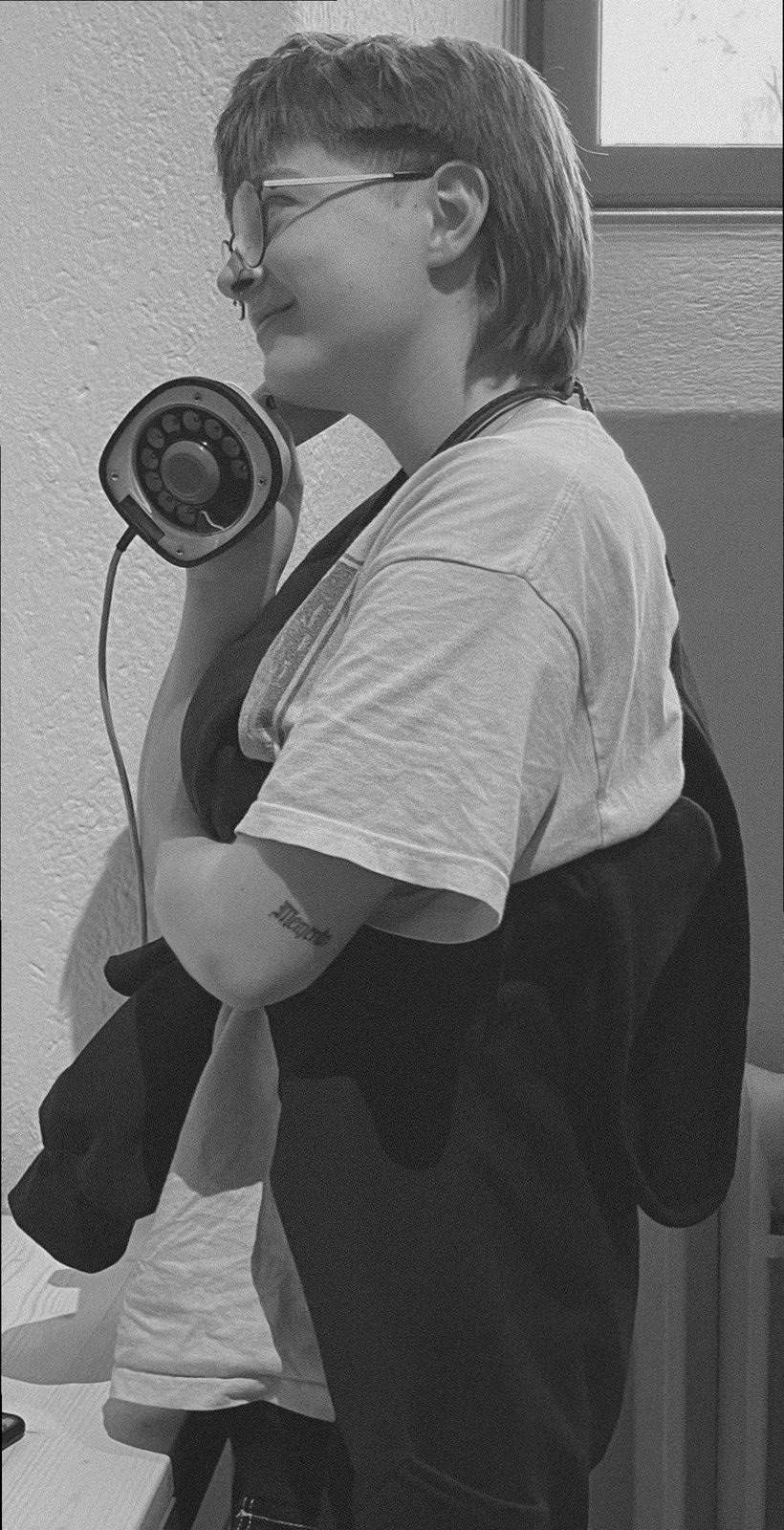
The first time someone picked up during the pilot and we had a real conversation.
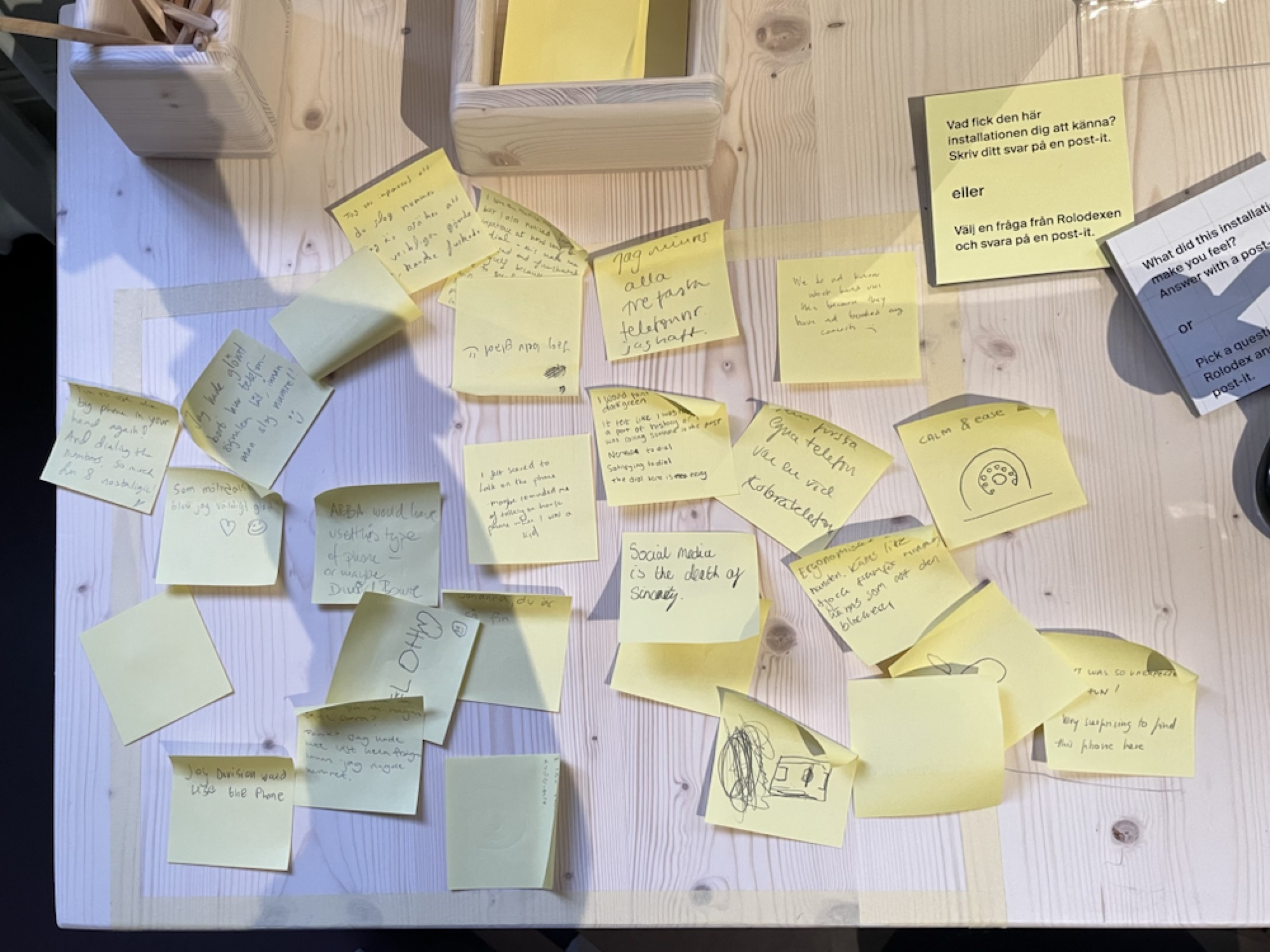
Reading the post-its for the first time.
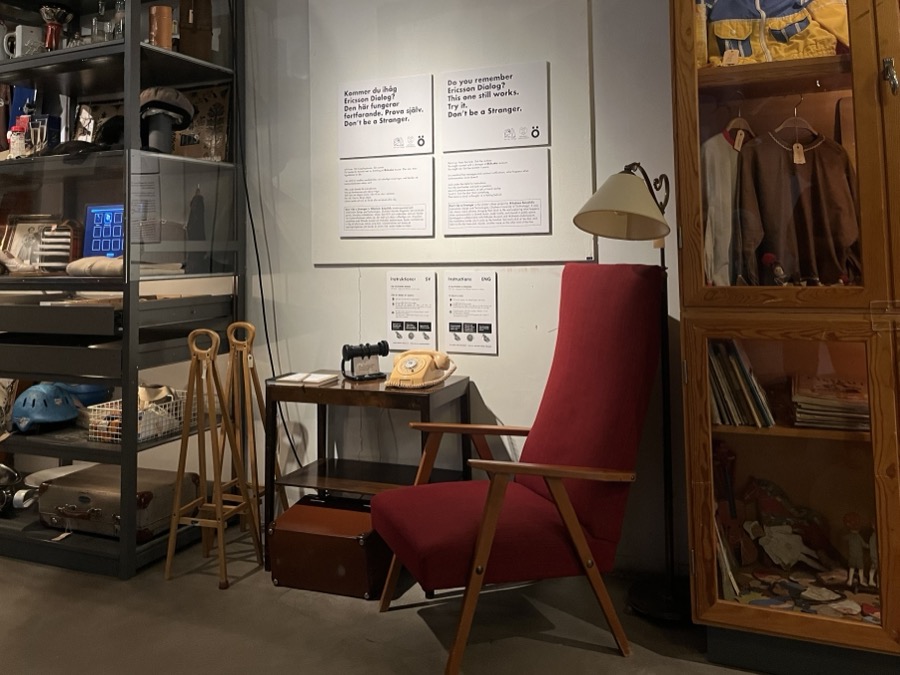
Calling from the Dialog in Mölndal and talking to a stranger standing in Röhsska.
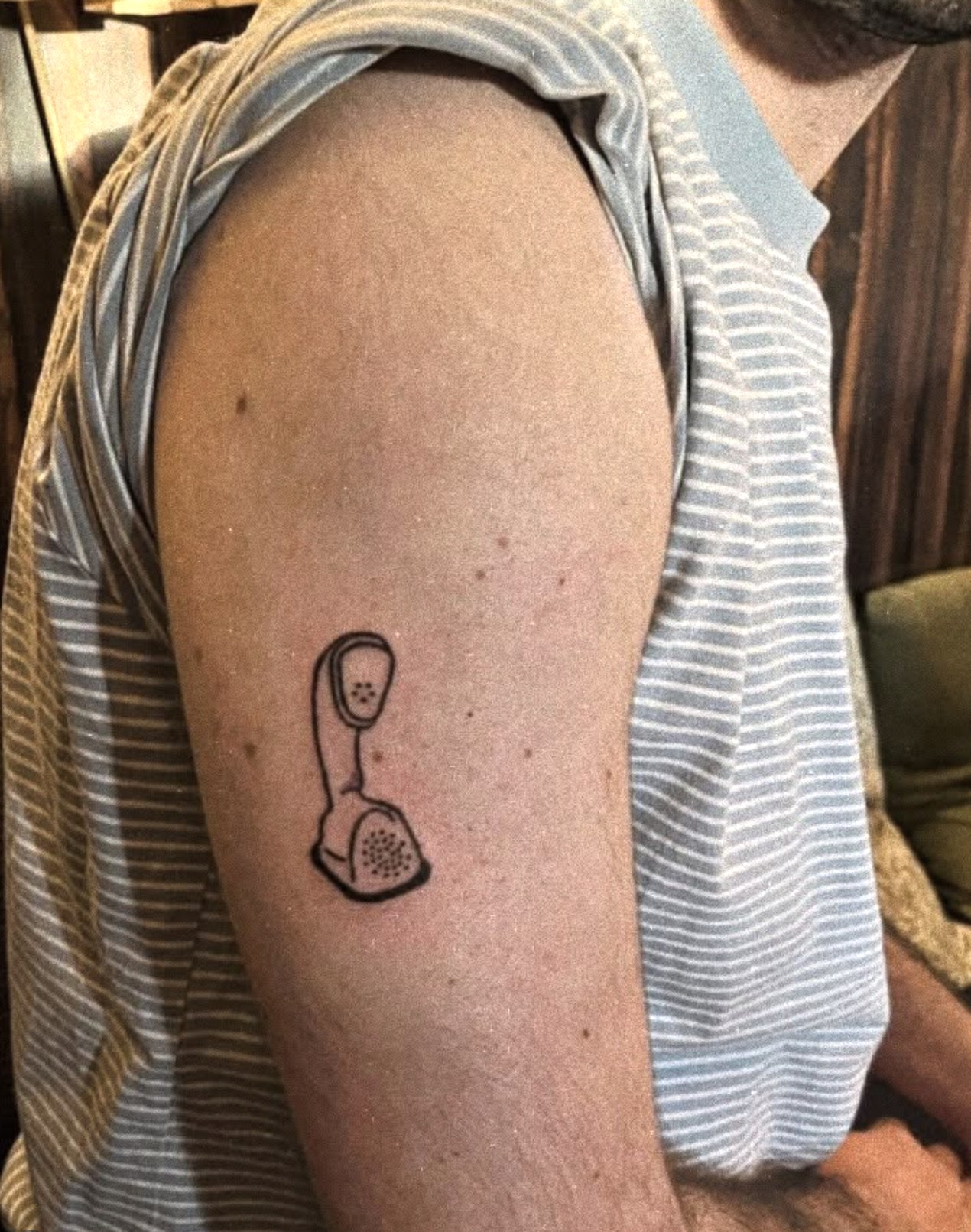
Getting the Ericofon tattooed on my arm.


01Voice and emotional presence
What does the voice carry that a text never could?
For anyone building something similar
- No screens, lights or caller info
- Semi-private: speak towards a wall, still in view
- Don’t promise a connection you can’t guarantee
In the museums
Voice only. No screen, no caller ID, and printed prompts that support the call rather than compete with it.

02Tactility and materiality
How does it feel to hold a phone that doesn’t fit in your pocket?
For anyone building something similar
- Keep the weight, the dial’s resistance, the ring
- Make the supporting material analog too
In the museums
The Kobra and the Dialog, weight and dial kept, and everything around them on paper: posters, a Rolodex, post-its.

03Invitation in public space
Would you pick up a ringing phone in a public space?
For anyone building something similar
- The room and the signage give permission
- Seed a few post-its before opening
In the museums
The museum’s own posters saying “Pick up the phone”, stools at a table, and a surface waiting for post-its.

04Defamiliarisation
What happens when something you know suddenly behaves a little bit strange?
For anyone building something similar
- Put the object inside the exhibition’s story
- Prompts that open a conversation, not test knowledge
In the museums
In Design Stories, a few metres from the Ericofons behind glass, with a Rolodex of prompts about voice, touch and memory.